Erskineville in the 1930s
In 1938 the New South Wales government picked Erskineville, and only Erskineville, to prove that the state could rehouse people. The Housing Improvement Board had been set up the year before under the Housing Improvement Act 1937 to clear slums; it surveyed several inner suburbs, Waterloo among them, and started work in exactly one of them. Fifty-six units went up on the western end of Erskineville Park. Then war broke out in 1939 and the money stopped, and that was the whole programme.
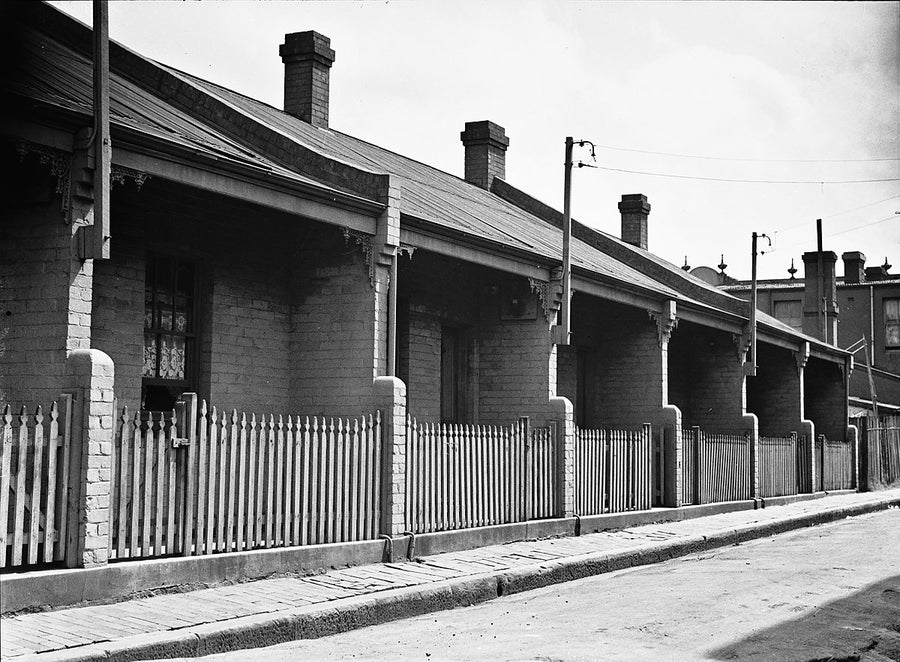
So 1938 finds the suburb being looked at very closely indeed. A woman gathers washing off the line in a paved backyard with a wicker pram behind her. A man in uniform and a woman holding a baby stand at the white picket fence of a weatherboard-and-brick cottage while a girl in a sun hat waits on the footpath. A terrace of single-storey brick cottages runs off down the street under bullnose verandahs and cast-iron brackets. Pictures like these cut both ways — a record of what was to be swept away, and of people quite plainly at home in it.
There is building work as well: an excavator loading spoil into a tip truck in a cut trench beside the railway, bricklayers at a wall. And there is one unmistakable arrival — two men carrying a stained-glass-fronted sideboard toward a doorway lettered *Flats 49 to 52*.
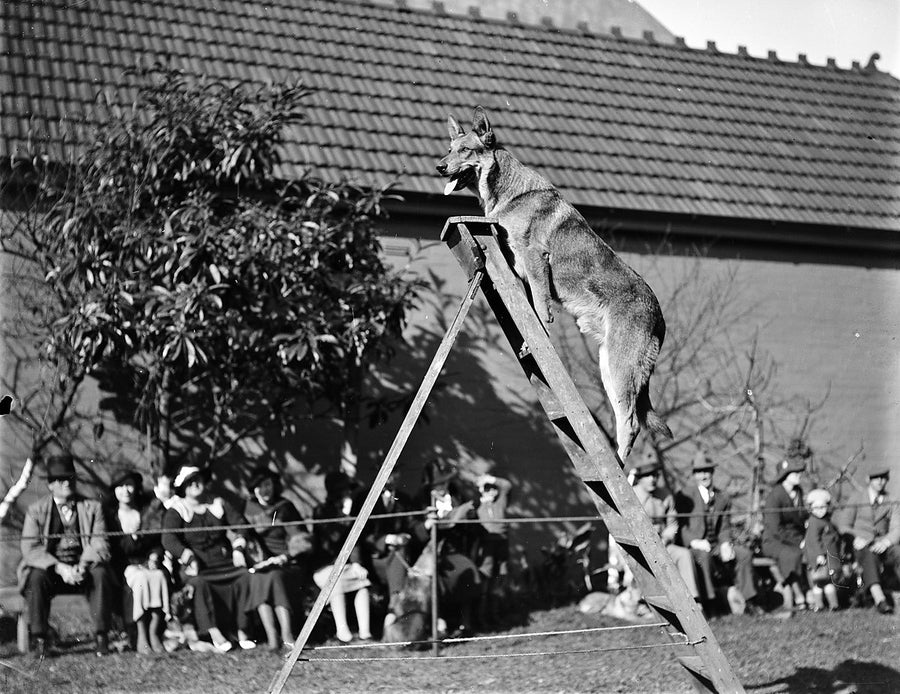
Erskineville also did other things with its afternoons. In 1934 the suburb held a dog show, and somebody photographed a German shepherd at the top of a wooden A-frame with its tongue out, and a small child in a knitted cap holding on to the rope barrier.